
Server-Side Conversion Tracking: The Complete B2B SaaS Guide
Learn how server-side conversion tracking works for B2B SaaS teams. Compare tools, avoid data loss, and build reliable backend tracking infrastructure.
Introduction
Client-side tracking is hemorrhaging data. Between ad blockers, ITP restrictions, and the slow death of third-party cookies, B2B SaaS teams relying solely on browser-based JavaScript tags are losing 25-40% of their conversion signals before they ever reach an analytics platform. Server-side conversion tracking solves this by moving event capture to your backend infrastructure, where ad blockers cannot interfere, and cookie restrictions become irrelevant. But migrating to server-side is not as simple as flipping a switch. The architecture decisions you make during implementation will determine whether you end up with a reliable, compliant measurement system or an expensive data pipeline that introduces more problems than it solves.

Why Client-Side Tracking Fails B2B SaaS Funnels
B2B SaaS conversion funnels are fundamentally different from e-commerce checkout flows. A typical SaaS funnel spans multiple sessions, devices, and weeks of evaluation before a prospect converts from trial signup to paid customer. Client-side tracking was never designed to handle that complexity, and the degradation is accelerating.
The Compounding Data Loss Problem
Every layer of the modern browser stack is working against client-side tags. The result is not just missing pageviews; it is systematically broken attribution that makes your paid channels look worse than they actually are.
Ad blocker interference: Roughly 30-40% of technical audiences use ad blockers that strip analytics JavaScript before it executes, creating silent gaps in your conversion data pipeline
Cookie expiration policies: Safari's ITP now caps first-party cookies set via JavaScript at 7 days, meaning returning visitors look like new users and multi-touch attribution models collapse
Consent banner drop-off: GDPR and CCPA consent requirements cause 20-50% of visitors to reject tracking cookies, and consent-driven tracking gaps compound across every session
Network latency and race conditions: JavaScript tags that fire on page unload events frequently fail to complete before the browser navigates away, silently dropping high-value conversion events
Cross-domain identity fragmentation: B2B buyers moving between your marketing site, docs, and app subdomains lose their identity stitching when cookies cannot follow them
When the Business Impact Becomes Unacceptable
The real cost is not abstract. When your tracking data accuracy degrades, your growth team makes budget decisions on incomplete information. Paid channels that actually drive the pipeline get defunded because conversions are not attributed. Product teams cannot distinguish engaged trial users from ghosts because half the behavioral events never fire. Once you recognize that your client-side implementation is systematically undercounting conversions by double digits, the case for server-side event tracking becomes obvious. The question shifts from "should we do this? to How do we architect it correctly?
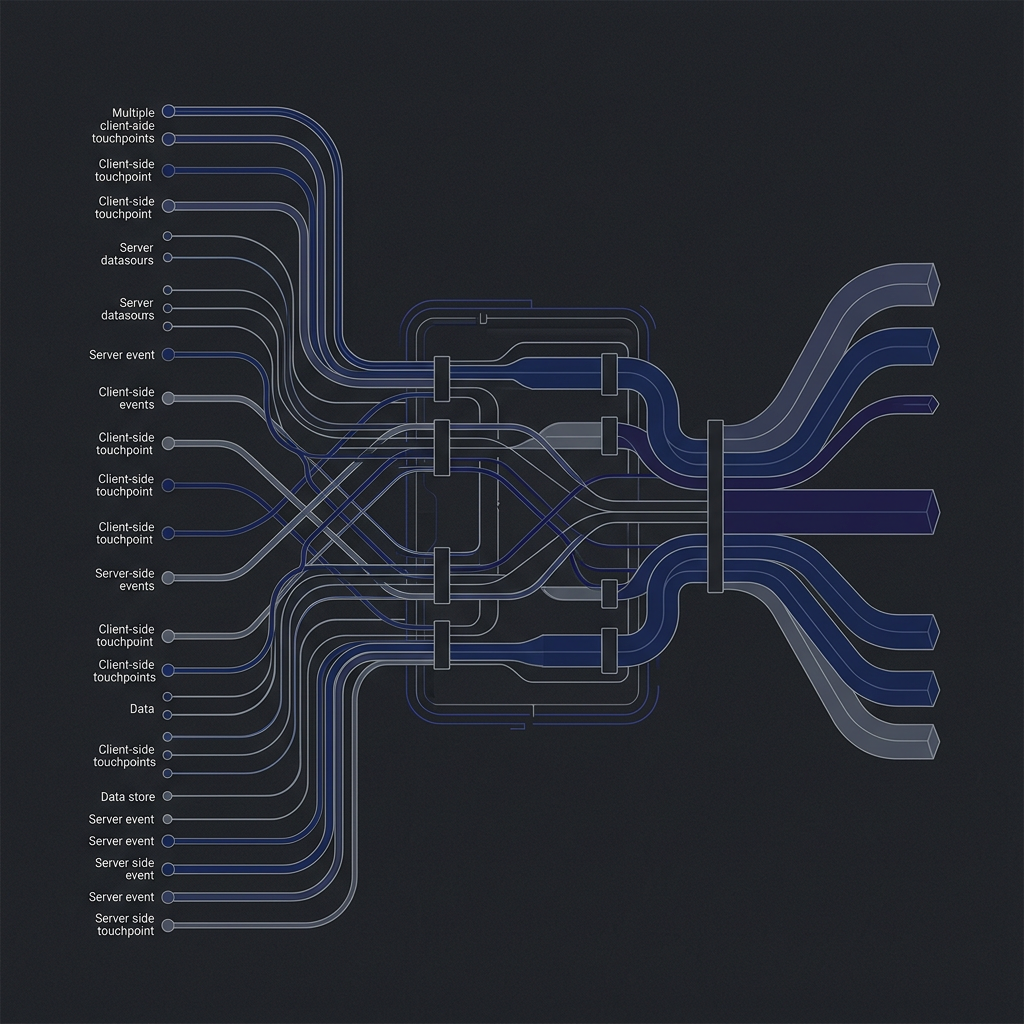
Architecting Your Backend Tracking Infrastructure
Moving to server-side tracking is an infrastructure project, not a tag management tweak. The architecture pattern you choose will depend on your team's existing stack, the volume of events you process, and how tightly you need to integrate with downstream tools like ad platforms, CRMs, and analytics platforms.
Choosing an Architecture Pattern
There are three common patterns for B2B SaaS server-side tracking, and each involves real trade-offs. The first is the API-to-API pattern, where your application server sends events directly to destination APIs (Google Ads, Meta, LinkedIn) via HTTP calls. This is the simplest to implement, but creates tight coupling. Every new destination means new integration code, and failures in one destination can create backpressure on your application.
The second pattern routes events through a Customer Data Platform like Segment. Your backend sends events to a single API endpoint, and the CDP handles fan-out to all destinations. This approach is popular because it abstracts destination complexity, but it introduces a dependency on a third-party vendor and adds per-event costs that scale with volume. The third pattern uses an event streaming platform like Kafka as the backbone. Events from your application publish to a Kafka topic, and consumers read from that topic to forward data to destinations, your warehouse, and real-time dashboards. This is the most resilient and flexible pattern, but it requires operational maturity to maintain.
Critical Implementation Decisions
Regardless of which pattern you choose, several decisions will determine whether your backend tracking infrastructure actually improves data quality or just shifts where the problems occur. First, define your event taxonomy before writing any integration code. Without a governed naming convention, you will end up with duplicate events, inconsistent properties, and a warehouse full of data nobody trusts.
Second, decide how you will handle identity resolution at the server layer. B2B SaaS funnels involve anonymous visitors who later authenticate, and your server-side implementation needs a strategy for stitching pre-auth and post-auth activity into a single user profile. This is where identity resolution frameworks become essential. Third, build retry logic and dead letter queues into every event forwarding path. Network failures will happen. If your server-side implementation silently drops events on HTTP timeouts, you have traded one data loss problem for another.

Tools, Privacy Compliance, and Avoiding Common Pitfalls
Selecting the right tooling and staying compliant are not separate workstreams. The tools you choose dictate your compliance posture, and your privacy requirements should filter your tool selection from the start.
Evaluating Server-Side Tracking Tools for SaaS
The server-side tracking tools comparison that matters for B2B SaaS comes down to four options. Google Tag Manager Server-Side (sGTM) is the most accessible entry point. It runs in a Cloud Run container, acts as a first-party endpoint for your domain, and supports the major ad platforms out of the box. If your team already uses GTM and your primary goal is restoring ad platform signal quality, sGTM is a strong starting point. Segment and RudderStack occupy the CDP layer. Segment offers the broadest destination catalog but charges per tracked user at scale. RudderStack is open-source and warehouse-native, making it attractive for teams that want to own their data pipeline end-to-end.
PostHog deserves mention for product analytics use cases where you want server-side event ingestion alongside feature flags and session replay. For enterprise server-side tracking at scale, the combination of Kafka plus a warehouse (Snowflake or BigQuery) plus a reverse ETL tool like Census or Hightouch gives you the most control. TrackRaptor has published detailed architectural breakdowns of each of these patterns, and the right choice depends heavily on whether your team optimizes for speed-to-implement or long-term flexibility. You can explore those comparisons at TrackRaptor.
Privacy Compliance Is an Architecture Concern
Server-side tracking does not bypass consent requirements. It changes where consent logic executes, but GDPR and CCPA obligations remain fully in effect. The advantage is that consent decisions can be enforced at the server layer with higher reliability than client-side consent management platforms, where tag firing order and race conditions frequently cause non-compliant data collection. Your server can check consent status before forwarding any event to a third-party destination, creating a single enforcement point instead of relying on browser-side tag sequencing.
Build your consent check into the event pipeline, not as an afterthought bolted onto individual destination integrations. Store consent records alongside event data in your warehouse so you can audit exactly what was sent, to whom, and under what consent state. This is where first-party data collection becomes a genuine privacy compliance advantage rather than just a marketing talking point. The teams that treat privacy as an architectural constraint from day one avoid the painful retrofits that hit everyone else when regulations tighten.
Conclusion
Server-side tracking is no longer optional for B2B SaaS teams that depend on accurate conversion measurement. The path forward starts with understanding exactly where your current client-side implementation is losing data, then selecting an architecture pattern that matches your team's operational maturity and infrastructure stack. Prioritize event taxonomy governance, server-side consent enforcement, and retry-resilient event pipelines over rushing to connect every possible destination. The teams that build this infrastructure thoughtfully will have a durable measurement advantage as browser-side tracking continues to degrade.
Start building your server-side tracking strategy with the deep-dive guides and architecture breakdowns at TrackRaptor.
Frequently Asked Questions (FAQs)
What is the difference between server-side and client-side tracking?
Client-side tracking executes JavaScript in the user's browser to capture events, while server-side tracking captures and forwards events from your application server, bypassing browser restrictions like ad blockers and cookie limitations entirely.
How does server-side tracking improve data accuracy?
Server-side tracking eliminates data loss caused by ad blockers, browser privacy restrictions, and JavaScript execution failures, typically recovering 25-40% of conversion events that client-side implementations miss.
Why is server-side tracking important for B2B SaaS?
B2B SaaS funnels span multiple sessions, devices, and weeks of evaluation, making them especially vulnerable to the identity fragmentation and cookie expiration issues that server-side tracking resolves.
What tools support server-side tracking?
Common options include Google Tag Manager Server-Side, Segment, RudderStack, PostHog, and custom Kafka-based pipelines, each suited to different levels of infrastructure complexity and team operational maturity.
How does server-side tracking handle privacy compliance?
Server-side implementations enforce consent checks at the server layer before forwarding events to any third-party destination, creating a single, auditable enforcement point that is more reliable than browser-side consent management.